
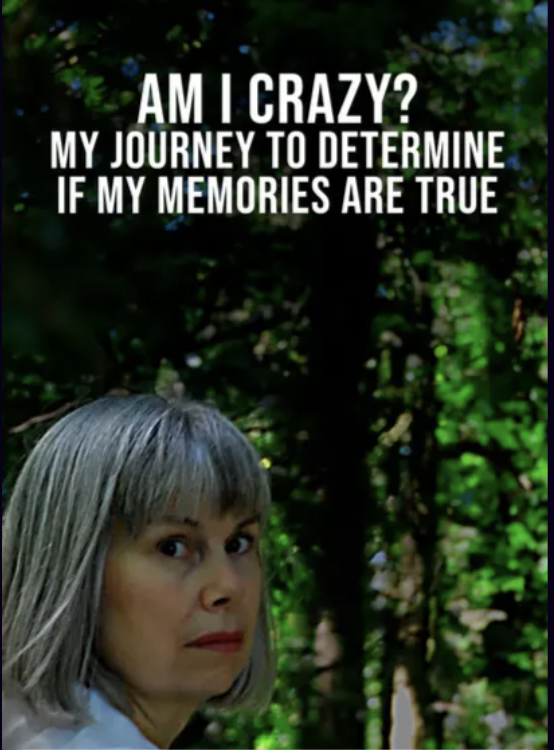
In the documentary Am I Crazy?, filmmaker Mary Knight takes us on a deeply human journey. One marked by humility, rigor, and an unusual willingness to be wrong. After long-buried memories of sexual harm re-emerge later in her life, Knight does not rush toward certainty. Instead, she turns directly toward doubt.
What follows is not a polemic, but an investigation.
Knight interviews some of the most prominent voices associated with the “false memory” movement: Pam Freyd, the founder of the False Memory Syndrome Foundation. Dr. Elizabeth Loftus, a high-profile psychologist who consults with defense attorney in cases such as Harvey Weinstein, Bill Cosby, Michael Jackson, and Ted Bundy. And Eleanor Goldstein, the author of Confabulations. She asks them, plainly and earnestly, whether her own memories might be false.
At the same time, the film is anchored by interviews with leading trauma experts, including Bessel van der Kolk, whose decades of clinical and neuroscientific research have helped shape our current understanding of how traumatic memory is stored, fragmented, and sometimes inaccessible until later in life. Knight also speaks with Marilyn Van Derbur, crowned Ms. America in 1957 and one of the earliest public voices to speak openly about child sexual harm at a time when doing so came at enormous personal cost.
What makes Am I Crazy? so compelling is not that it “debunks” false memory theory outright, but that it lets the viewer witness something more complex and more human. We hear from Pam Freyd's daughter, Dr. Jennifer Freyd who is herself a survivor of sexual harm and a leading CSA educator and author of "Betrayal Trauma". We watch as Dr. Elizabeth Loftus struggles to articulate how her own sexual harm at age 6 has never impacted her life.
And perhaps most compelling, we watch a painful scene as Eleanor Goldstein, whose daughter has also come out publicly about her own sexual abuse, defensively reveals her own misunderstandings of the impact of sexual harm on a child. The film does an amazing job demonstrating how those champions of denying sexual harm to children are so often non offending parents, survivors unwilling to face their own harm, or the offenders of harm finding cover behind these theories.
Knight does not mock this pain. She listens to it. And in doing so, the film gently exposes how much of the false memory movement is driven not by solid science, but by the terror of what acknowledging child sexual abuse would demand of us personally, relationally, and socially.
Am I Crazy? models something rare in our current discourse: curiosity without collapse, compassion without denial, and a deep respect for both science and human vulnerability. It invites us to consider that remembering is not an act of betrayal, and that disbelief, while an understandable protector, often comes at a profound cost to those who are already carrying too much.